Yearly Archives: 2016

Can’t Wait to See You in My Courses in Semester 1 of 2017!

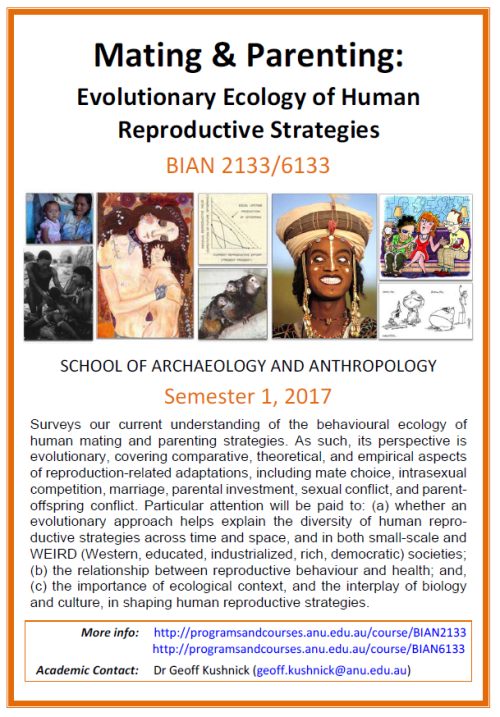
The 2016 academic year is coming to a close here at The Australian National University. Five semesters under my belt, and I feel like I’m finding my groove. We’re starting to advertise our classes for Semester 1 of the 2017 academic year, starting in February, so I thought I’d share the posters for the two classes I’ll be teaching.

I’m very excited to be teaching two courses so closely related to my research interests and expertise in human behavioural ecology in the same semester. You bet I’ll be talking a lot about my own research in these courses:

  • ‘Evolution and Human Behaviour’ (BIAN 3124/6124)
  • ‘Mating and Parenting’ (BIAN 2133/6133)

Do either of these classes sound interesting to you? If so, I’d love to have you. As always, I’ll be keeping my eye out for star performers ready to join the ranks of my honours, masters, and PhD students!

BIAN 3124 6124 poster.PNG

BIAN 2133 6133 poster.PNG

Leave a comment

Filed under Uncategorized

ANU Students Critically Evaluate Popular Books on Human Evolution

20161011_122152.jpgWhy do men and women look for different things in a significant other? What can the behaviour of other animals tell us about human behaviour? Are popular books on the topic oversimplified? Or can we learn something of value from them?

The students in my course at The Australian National University explored these issues and others, while sharing their critical evaluations of popular literature on human evolution this week in a Poster Faire.

They produced the posters as a requirement for the course ‘Sexual Selection and Human Evolution’ (BIAN 2132/6132).

And they had great fun doing it! The course’s 56 enroled students were split into 3 groups. Each group presented for 1 hour, and then each student came to serve as the audience for one of the other hours. And, the students enjoyed it:

“The poster faire really served as an interactive platform where students were able to give their perspectives on some very interesting topics and was a fun way to dive deeper into the course material. I definitely gained new insights and really have been persuaded to read some of the books that were presented. ” – Inez Derkx

Click here to see the Poster Faire Gallery — high-resolution images of posters, and some additional photos of the Poster Faire and the participants.

Leave a comment

Filed under Uncategorized

What exactly are Anthropology MAs doing with their anthropology?

Great blog post about what anthropology MAs do after graduation by Chrislyn Laurore.

Leave a comment

Filed under Uncategorized

How to Read for Grad School

Looks like great advice!

Miriam's avatarMiriam E. Sweeney

Books

In graduate school the work load increases and students will find that they are expected to master two to three times the material that they were used to as an undergraduate.  This can be intimidating to the point of overwhelming a student into paralysis.  Following these tips should help you master your readings instead of allowing the readings to master you!

1.     Read Strategically, Not Linearly. Reading for graduate school is different than reading a book for pleasure.  When we read for pleasure we often start at the beginning of the book, reading carefully in a linear fashion.  If you do this with your academic material, it will take twice as long and it is likely you won’t retain the right kind of information from the reading.  Instead of reading linearly, read strategically.  As an academic reader your job is to mine the text you are reading for information. …

View original post 918 more words

Leave a comment

Filed under Uncategorized

Decline of Cousin Marriage among the Karo: A Case of Sexual Conflict?

geokush's avatarImpal Marriage Study

One goal of this study was to collect data on Karo people’s perceptions of the reasons for the low rate of impal marriage. The results of the ‘experimental’ part of my Fulbright project have been published in the journal Human Nature.

Impal Couples1 Karo couples married from the 1950s to the present.

My co-authors and I found a number of interesting things, including that Karo people find the prospect of someone marrying a cousin with whom they are unfamiliar much more distasteful than marrying one who with whom they have a close relationship. This runs counter to Westermarck’s negative imprinting hypothesis.

The age and gender pattern of responses suggests that women’s perception of the practice has remained steady while men’s perceptions have become increasingly negative. Taken together with a gender difference…

View original post 157 more words

2 Comments

Filed under Uncategorized

Biological Anthropology Postgrads Shine at ANU’s Student Research Conference

20160718_120343

ANU biological anthropology masters students Tara-Lyn Carter and Ben Gleeson

ANU Master of Biological Anthropology students Tara-Lyn Carter and Ben GleesonI’m pleased to report on the distinguished accomplishments of two Biological Anthropology postgraduate students with whom I’ve worked closely. Both have won accolades at The Australian National University’s (ANU) Student Research Conference on the 14th and 15th of July, 2016.

  • Tara-Lyn Carter won 1st prize for postgraduate presentations for her talk on “Behaviour and Beliefs Related to Male Aggression: Evidence of Intrasexual Selection in Humans?” — a project that we are working on together (see our paper’s preprint on PeerJ Preprints and a previous blog post about the project).
  • Ben Gleeson received a judge’s commendation for his talk on “The Effect of Female Social Status on Human Stature Sexual Dimorphism: Evidence of Self-Domestication?” This work is related to the thesis Ben is doing for his Master of Biological Anthropology degree, a project that I am supervising.

Both have been invited to post their slides in the ANU Library’s new digital repository for the conference. More information can be found on the conference’s Facebook page.

Congratulations to both of you for a job well done!

Leave a comment

Filed under Uncategorized

Small Victories on the Road to Getting More Exposure (for my Research)

One of the reasons I’m keeping this blog is to bring attention to my work. I’ve admittedly not done the best job of this in the past, but there were reasons. So hear me out.

Before coming to ANU in 2014, I held a non-tenure track job at the University of Washington in Seattle for 7 years. It was a great job and I got to become a colleague of the same people who were once my professors (UW was my PhD alma mater — go Huskies!). This made it hard to spend a lot of time promoting my research for a couple reasons.

First, I spent a good proportion of each of those 7 years hunting for the perfect job. Scouring the job ads, writing applications, and traveling for interviews. So, although I was publishing, I just didn’t have the time to bring attention to my work elsewhere.

Second, because I was not on a tenure-track at UW, I didn’t have access to conference funding. That meant that I didn’t get to do a lot of the things that conferences are good for (i.e., presenting and networking). I just didn’t have the resources.

****

I feel like things are changing now that I have a more permanent job. I’m able to spend more time promoting my research. And, its paying off.

Check out the screenshot from my Academia.edu profile. I’m in the top 3% as of late of all researchers using that service in terms of page views.

academia 3% 10 jun 2016

Also, take a look at the program for the upcoming Annual Meeting of the Human Behavior and Evolution Society (HBES) in Vancouver, Canada. I’m a co-author on two papers. Plus, I have funding support to go to the conference! My first time since I was young PhD student in 2000 (okay, I also went to 1 day of the conference in 2007 or so because it coincided with an interview I had at the hosting university, and it was close enough to my parent’s house to make it work without funding).

I’m so excited to go to the conference! Hope to see you there…

Leave a comment

Filed under Uncategorized

Debating moral judgment: Some commentary on our recent paper

Some interesting back-and-forth commentary on a recent paper that I co-authored with my colleagues on the UK Arts and Humanities Research Council’s “Culture and the Mind” Project:

pnasBarrett HC, Bolyanatz A, Crittenden AN, Fessler DMT, Fitzpatrick S, Gurven M, Henrich J, Kanovsky M, Kushnick G, Pisor A, Scelza B, Stich S, von Rueden C, Zhao W, Laurence S (2016) Small-scale societies exhibit fundamental variation in the role of intentions in moral judgment. Proceedings of the National Academy of Sciences, USA, 113(7), 4688-4693.

PDF  Link  Data  Blog

The blogs are hosted by the International Cognition & Culture Institute:

Leave a comment

Filed under Uncategorized

Culture and deforestation in the Pacific: A phylogenetic perspective

Picture1

My colleagues and I conducted a comparative study of pre-European deforestation and reforestation (referred to hereafter as ‘forest outcomes’) on 70 Pacific islands (Atkinson et al 2016). Our aim was to see if any cultural, especially agriculture and land ownership norms, or geographic aspects of locations on those islands were associated with forest outcomes.

We published the results of the study in PLoS ONE, an open-access journal published by the Public Library of Science.

Atkinson QD, Coomber T, Passmore S, Greenhill SJ, Kushnick G (2016) Cultural and Environmental Predictors of Pre-European Deforestation on Pacific Islands. PLoS ONE 11(5): e0156340.  Link   PDF

Using comparative methods one can test hypotheses about functional relationships (i.e., about cause and effect). It is like choosing 100 kids that vary in candy consumption and testing the hypothesis that, if sugar causes cavities, you should see more cavities in the kids that eat more candy.

Of course, without conducting a controlled experiment, it’s hard to say anything definitively about causation. Poor health habits, for instance, may lead to eating tons of candy and never brushing your teeth. In those 100 candy eaters, was the higher incidence of cavities due to candy or poor dental hygiene?

The same goes in comparative cross-cultural studies like the one we’ve conducted. There are inter-dependencies in the data for a number of reasons, including shared environments and cultural history (for example, is there really a causal relationship between mountainous environment and prevalence of polyandry, or is there just a cluster of Himalayan societies that all live in the mountains and that all engage in this practice because their ancestors did?)

To control for cultural history and shared environments, we used phylogenetic methods — yes, the ones used more commonly in evolutionary biology to look at evolutionary relationships amongst species.

We found that geographic and cultural factors are associated with forest outcomes, but there was little phylogenetic signal. This suggests “that forest outcomes were not tightly constrained by colonists’ cultural ancestry, but instead reflect a combination of ecological constraints and short-term responses of each culture in the face of those constraints” (Atkinson et al 2016).

What was my role in the study?

I was enlisted by the lead author of this study to help provide data on land tenure for the societies on the focal islands. This required many hours of work reading dusty, early 20th century tomes on Pacific ethnography — which I loved of course. I also provided feedback on the analyses and helped to write the paper.

My previous work on the evolution of land tenure norms in societies of SE Asia and the Pacific was published in 2014. Click here to download that paper.

2 Comments

Filed under Uncategorized

Steve Pinker demolishes John Horgan’s view of war

whyevolutionistrue's avatarWhy Evolution Is True

As you may recall, Science Contrarian John Horgan’s notorious “admonition to skeptics” blog post at Scientific American criticized the entire skeptical community for its supposed failure to campaign against war. That “hard target”, said Horgan, should take precedence over our attempts to attack “soft targets” like homeopathy, global warming denialism, and opposition to vaccination and GMO foods.  But he also criticized those who propounded what he called the “deep-roots theory of war”.  Let me refresh you on what he said (note that every single one of his “references” goes to a Horgan blog post!):

Horgan:

The biological theory that really drives me nuts is the deep-roots theory of war. According to the theory, lethal group violence is in our genes. Its roots reach back millions of years, all the way to our common ancestor with chimpanzees.

The deep-roots theory is promoted by scientific heavy hitters like Harvard’s Steven Pinker, Richard Wrangham and Edward…

View original post 1,127 more words

Leave a comment

Filed under Uncategorized